Central Arizona Chapter
Modules

Standards
To make a modular layout work, standards are necessary so that abutting
modules will have track and catenary alignged, eleectrical connections
matched, etc. We have chosen to use the ETE Southern California Chapter
be our guide. The exception to this is to use Molex electrical
connections between modules to reduce the costs. For detailed
information, see Module Wiring.
A few "bridging"
cables to match our connectors with SoCal's will be made up. Other than
that, the overall standard is based on the national ETE HO module
standard. For information on the the Molex connectors with pinouts,
and another take on module design see Andy Hohl's Module Design document.
The original corner modules were implemented with a track "gap" at the
end of the modules. In order to standardize our modules, this gap had
to be elimiinated. Here are instructions for extending the track to the module end.
Work in progress
October 2008
We have constructed four corner modules which are the property of the
Chapter. With these, we can put together a continuously running layout,
or by removing one or more corners, assemble a point to point layout.

Figure 1. All four corner modules connected, and Märklin K
track layed to align.
To make sure the modules align properly, we have a metal template we
purchased from the SoCal Chapter.

View of the leg work.

Bolts with wing nuts for easy connection and disconnection.
August 2009
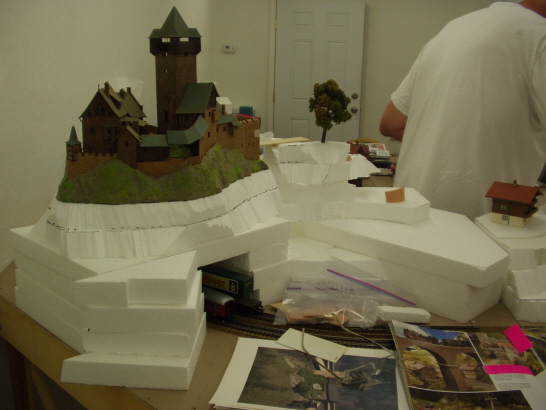
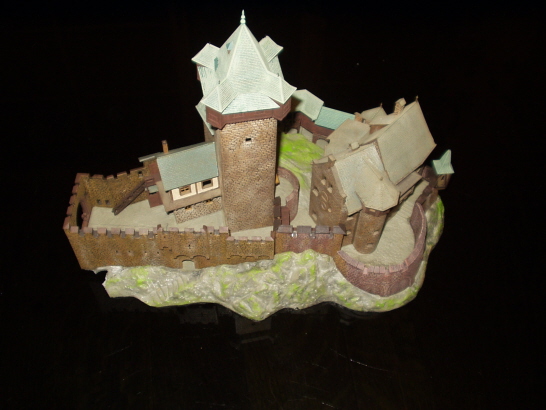
Work on scenery for one of the corner modules. Kent Taylor has
contributed the Kibri Falkenstein which was started by his dad, Sam.
Kent has been working to complete the model and fit it onto the Sam
Taylor Memorial Module. The team has been working on creating mountains
from foam, and building other strutures.

October 2010
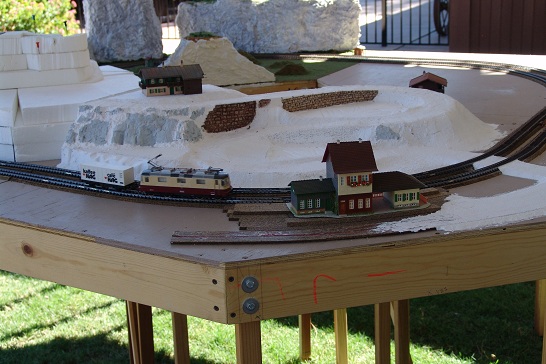


Tim and Karen Johnson provided scenery for one of the corner modules
which
includes mountains and a waterfall. The mountains are constructed of
insulating foam boards. These were hot glued together, then cut with a
hot wire
to the desired shapes. Later, a plaster-like substance called Foam CoatTM
was applied, and rock castings were added while the Foam Coat was
still wet.
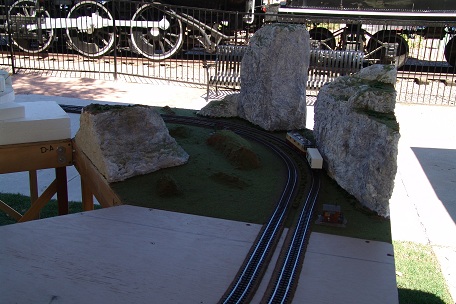


The waterfall was made from Woodland Scenics Realistic WaterTM
then Woodland Scenics Water EffectsTM.
Once the Water Effects
had set, white paint was dry brushed over it so simulate falling
water.
October 2013
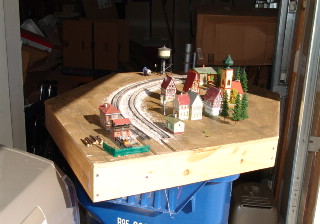
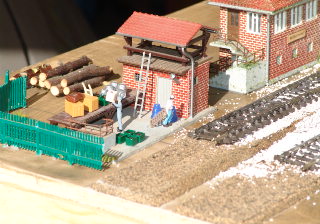
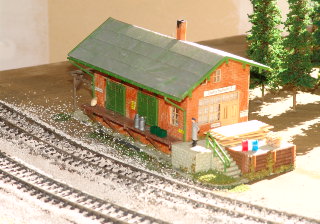
John Leipisc took our last unseniced corner module, and added
structures from his retired German layout. John installed lights in
the buildings to add night interest.

Progress on straight modules can be found here.
Next steps